




Irregular menstrual cycles weight gain unresponsive to diet and exercise. Unexplained skin eruptions appearing despite you having moved past your teenage years some time ago.
Introduction
These are some of the symptoms of PCOS/PCOD and if they ring a bell with you then you should know that it is one of the most widespread endocrine disorders in women. And although PCOS/PCOD has a lot of information available on the web, unfortunately, most of it is either extremely complicated jargon or plain generalizations. This disorder causes problems with ovary function as well as leads to irregular cycles, weight changes, and difficulties with conception.
However, there are some clinical differences between PCOS and PCOD but for most women it does not matter which one of the two they have as what really counts is the right moment to start the treatment.
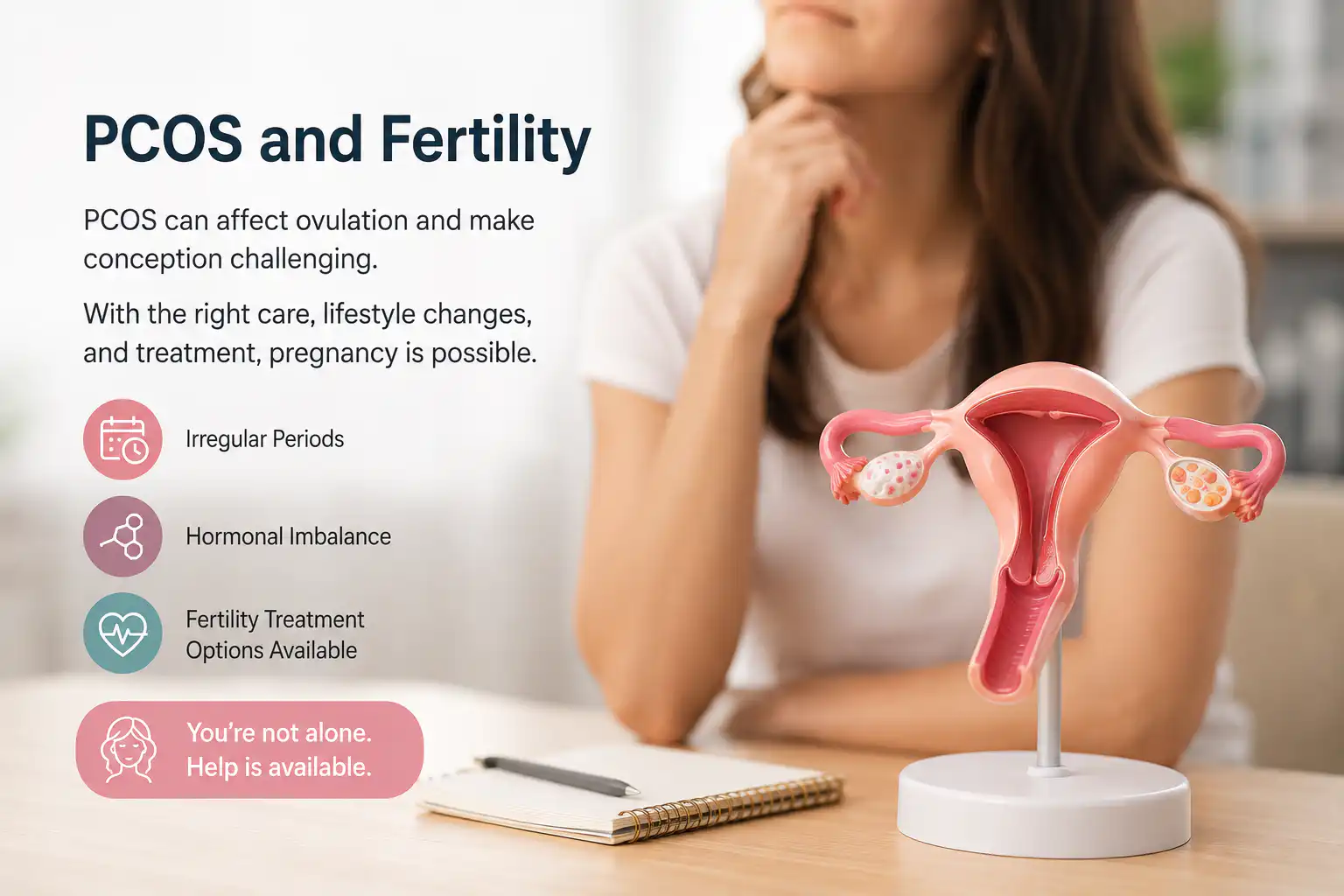
What Actually Happening
What Is Actually Happening in Your Body
PCOS disrupts the hormonal signals that tell an egg to mature and be released. In a typical cycle that process runs on a relatively predictable schedule. In PCOS it does not. Some months ovulation happens late. Some months it does not happen at all. Some women have cycles that stretch to fifty or sixty days. Others stop getting periods regularly altogether.
On top of the ovulation disruption, most women with PCOS have elevated androgen levels, which are male hormones present in all women but higher in PCOS, and many have insulin resistance. These are not separate problems.
They feed into each other. The insulin resistance drives the androgen excess which drives the disrupted ovulation. Understanding this chain is what makes PCOS treatment make sense rather than feeling like a random collection of recommendations.
Lifestyle Piece
The Lifestyle Piece Is Not a Consolation Prize
Every woman with PCOS has been told to eat better and exercise more at some point. And plenty of them have rolled their eyes at it, fairly, because it can feel like a way of not giving real medical help.
But here is why it actually matters. In women with PCOS and insulin resistance, reducing that insulin resistance through diet and physical activity directly reduces the hormonal disruption that is suppressing ovulation. It is not vague wellness advice. It is targeting the mechanism that is causing the problem.
Some women find that consistent lifestyle changes restore regular ovulation without anything else. Others find it improves how they respond to medication. Either way it is part of the treatment, not a prelude to it.
What Treatment
What Treatment Actually Looks Like
For women looking for Treatment for PCOS / PCOD in Anand, a good specialist starts with a proper picture of what is actually going on. Menstrual history, symptoms, hormone blood tests, ultrasound to look at the ovaries. And importantly, an assessment of the partner’s fertility too, because treating one side of a two-partner situation and ignoring the other wastes everyone’s time.
If ovulation is the main issue, medication to stimulate ovulation is usually the starting point. This needs monitoring because women with PCOS can respond more strongly to these medications than expected, and that response needs to be managed carefully. This is not a take-the-pill-and-wait situation. The monitoring is part of what makes it work safely.
If ovulation induction does not result in pregnancy after a reasonable number of cycles, IUI may be the next conversation. If there are additional fertility factors, or if earlier approaches have not worked, IVF becomes relevant. PCOS does not automatically lead to IVF. But it is a real option and for some women the most efficient path.
Stop Waiting If Your Cycles Are Very Irregular
The general advice that couples should try for twelve months before seeking help assumes that ovulation is actually happening on a regular basis. If your cycles are wildly irregular or have largely stopped, that assumption does not hold. You are not in the same situation as someone with regular cycles trying to time conception correctly.
If periods are very unpredictable or mostly absent, seek an evaluation sooner. Not because something is definitely seriously wrong. But because finding out what is happening and what the options are is genuinely more useful than waiting and hoping things regulate on their own.
A consultation does not commit you to treatment. It just gives you information. And information, in this situation, is almost always better than uncertainty.
PCOS Does Not
PCOS Does Not End When Pregnancy Is No Longer the Goal
Women who are not currently trying to conceive still need to manage PCOS. The condition has long-term implications for metabolic health, cardiovascular risk, and blood sugar regulation. Regular monitoring, consistent lifestyle habits, and follow-up with a doctor matter whether or not pregnancy is on the agenda right now.
And please do not self-medicate based on what worked for someone in an online forum. PCOS looks different in different women and treatment that is right for one person can be wrong for another. The individualized part of the treatment is not just polite language. It is genuinely how the condition works.
Conclusion
PCOS is difficult. And that in itself is something. But on the other hand, it is far from being the end of the road for fertility for most women.
When seeking Treatment for PCOS / PCOD in Anand, the right kind of doctor will never follow a routine course of treatment in case of you. Instead, the individualized treatment approach is what will be taken into consideration, depending on your individual hormone levels, menstrual history, lifestyle, fertility of your partner, and your future plans.
Ready to Take the First Step?
Book a Consultation: Take the first step toward managing PCOS and improving your chances of conception with personalized fertility care.
Dr. Dipan Thakkar
Obstetrician & Fertility Specialist
35+ years of experience in obstetrics, maternity care, and advanced fertility treatments at Usha Nursing Home, Anand.
- Quick Facts
- Key Takeaways
- PCOS can affect fertility primarily by disrupting ovulation, leading to irregular, delayed, or absent periods.
- Insulin resistance and elevated androgen levels can contribute to hormonal imbalance and irregular ovulation in women with PCOS.
- A proper fertility evaluation should consider both partners, including menstrual history, hormone testing, ovarian assessment, and male fertility factors.
- Ovulation-induction medication is often an initial fertility treatment when irregular ovulation is the main issue, but it should be medically monitored.
- IUI or IVF may be considered when ovulation induction is unsuccessful or when additional fertility factors are present. PCOS does not automatically mean IVF is required.
- Women with highly irregular or absent periods should consider seeking fertility evaluation earlier rather than simply waiting for 12 months.
- Book a Consultation
Book a consultation today and get personalized guidance for managing PCOS and your fertility journey.